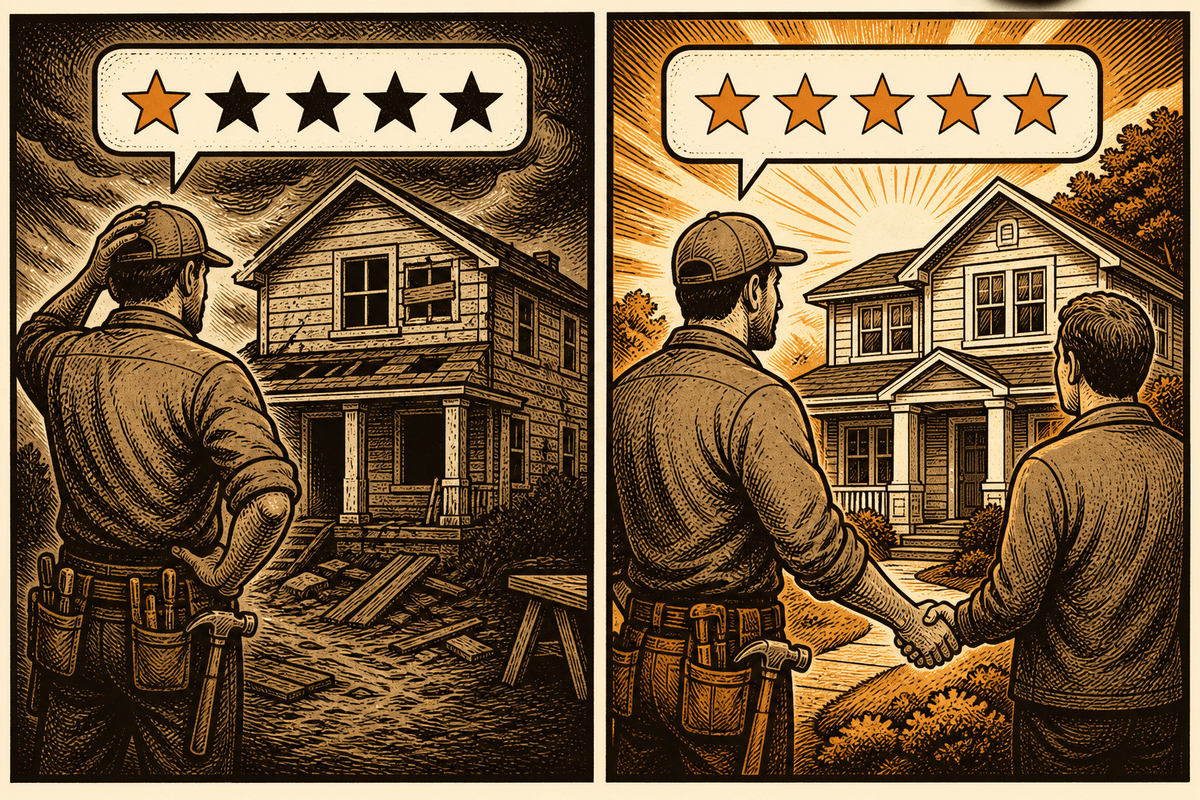
You finish a job. The customer seemed fine. Then you check your Google Business Profile and there it is: a one-star review, a name you barely recognize, and a complaint that doesn't match what actually happened.
Your first instinct is to fire back. Don't. Your second instinct is to ignore it and hope it disappears. Also don't.
How you respond to a negative review is one of the most visible things you do as a contractor. Future customers read those responses before they call you. What you write in the next five minutes can either recover the situation or confirm every fear that reviewer just planted.
This is how to handle it correctly.
Why Your Response Matters More Than the Review Itself
Most homeowners expect to see a bad review or two. A perfect 5.0 rating with 200 reviews can actually look suspicious. What they're really evaluating is how you behave when something goes wrong.
A calm, professional response to a tough review tells prospects: this contractor handles problems like an adult. A defensive, emotional response tells them: stay away.
Prospective customers are not judging the reviewer. They're judging you.
The Five-Part Response Formula
Keep this structure in your back pocket. It works for everything from a billing complaint to a "they were rude" review with zero details.
1. Acknowledge, don't dismiss
Start by naming the experience, not defending yourself. Something like: "Thank you for taking the time to share this. We're sorry the experience didn't meet your expectations."
You don't have to agree with the review. You're acknowledging that the customer had a bad feeling. That's different.
2. Use their name if you have it
A personalized response reads as genuine. A generic one reads as automated. "Hi Sarah" beats "Dear Customer" every time.
If the reviewer is anonymous or the name doesn't match any customer you can identify, skip it. Don't guess.
3. Take it offline fast
Do not litigate the job details in a public reply. You'll lose even if you're right.
Instead: "We'd like to make this right. Please call us at [number] or email [address] and we'll talk through it directly."
This moves the conflict out of public view. It also signals to every reader watching that you're serious about resolution.
4. Keep it short
Three to five sentences max. Long responses look defensive. Short responses look confident. Say what you need to say and stop.
5. End on a stable note
Close with something like: "We stand behind our work and want every customer to feel good about the experience. We hope to connect soon."
This is not groveling. It's professional. It shows character without conceding fault you don't owe.
What to Do When the Review Is Flat-Out Wrong
Sometimes the review is fabricated. Sometimes it's a competitor. Sometimes it's a customer with a grudge who exaggerated or invented details.
The response formula still applies. Calm, brief, redirect to a direct conversation. Don't call them a liar in your reply.
Here's what you can do in parallel:
- Flag the review in Google Business Profile as a policy violation if it violates Google's content policies (fake reviews, hate speech, irrelevant content). Google does sometimes remove them.
- Document your records: photos, signed contracts, text messages, invoices. If the review escalates, you have your case ready.
- Respond publicly once, calmly. Then stop engaging on that thread.
Chasing a fake reviewer in public comments is a losing game. One professional response, then move on.
The best defense against one bad review is ten good ones surrounding it. Volume matters. A single 3-star review in a sea of 4.9-star reviews doesn't move the needle. Thin review profiles let one complaint define you.
How to Respond to Negative Reviews as a Contractor: Real Examples
Here's what a bad response looks like, and then what a good one looks like, for the same situation.
The complaint: "They left a mess in my yard and the foreman was rude."
Bad response:
"We always clean up after every job and our foreman has been with us for 8 years. This is not accurate and we believe this may be a case of mistaken identity. We have no record of this customer."
This sounds defensive, dismissive, and combative. Future readers see a contractor who argues with customers.
Good response:
"Thank you for the feedback. We take site cleanup and crew conduct seriously on every job. We'd like to learn more about what happened. Please call us at [number] so we can address this directly. We appreciate the chance to make it right."
Same situation. Completely different public impression.
Speed Counts
Respond within 24 to 72 hours. A week-old unanswered review signals that either you don't care or you didn't notice. Neither is a good look.
Set up a Google Business Profile notification so reviews hit your email or phone in real time. Don't find out about a bad review two weeks late from a friend who saw it.
If you're using Reasonable Reviews through Fully Loaded Websites, this is monitored for you. New reviews get flagged. You get alerted. You're never caught flat-footed.
The Real Fix: Volume and Systems
Responding well to bad reviews is a damage-control skill. Building a review system is how you make bad reviews structurally irrelevant.
When you have 80 or 100 Google reviews averaging 4.8 stars, one 2-star complaint doesn't define your profile. When you have 11 reviews and one of them is a 1-star, that's a problem. The math is simple.
Most contractors don't have a review problem. They have a volume problem. They rely on the occasional happy customer to leave a review on their own, which almost never happens consistently.
You have to ask. You have to make it easy. You have to do it on a system, not when you remember.
That's exactly what Reasonable Reviews is built to do. It's one of the 15 tactics in the Fully Loaded Websites Marketing Matrix. Instead of hoping customers review you, you have a process that asks them at the right time, points them to the right platform, and builds your profile month over month without you chasing anyone down.
More 5-star reviews protect you from the occasional negative one. They also push your Google Business Profile higher in local search results, which means more calls from people who haven't heard of you yet.
You can learn more about how Evan sets this up by visiting the Meet Evan page. Or browse the portfolio to see what review systems and web presence look like in practice for local service businesses.
When a Review Deserves a Real Apology
Sometimes the review is right. The crew did leave a mess. The job did run long. The communication did fall apart.
Own it. Briefly and specifically.
"You're right that the cleanup on this one wasn't up to our standard. We've addressed it with the crew. Please reach out and we'll make it right."
That kind of honesty builds more trust than a defensive denial. Customers respect contractors who can say "we dropped the ball, here's what we're doing about it."
What damages trust is pretending problems don't happen. Every homeowner knows jobs don't always go perfectly. They want to know you'll handle it.
What Not to Do: The Short List
- Don't respond when you're angry. Write your draft, wait an hour, then decide if you'd say it to a customer's face.
- Don't ask the reviewer to take it down in your public response. That looks desperate and often violates review platform policies.
- Don't paste the same response to every review. Google's algorithm and real readers both notice copy-paste replies.
- Don't post fake positive reviews to bury the negative one. This violates Google's policies and can get your entire profile penalized.
- Don't go silent. No response is also a response, and it reads as indifference.
Connect Your Review Strategy to Everything Else
Reviews don't live in a silo. They feed into your Google Business Profile ranking, your website's credibility, and the first impression every new visitor gets.
A strong review profile pairs directly with a strong website. If someone reads your reviews and then lands on a slow, outdated site that doesn't load right on their phone, you lose them anyway. The FLW advice blog covers this combination in detail, including how page speed and trust signals work together to convert curious visitors into actual calls.
The review generation system guide covers the ask cadence, the right timing after a job, and how to use a direct link to make it easy. If you want to go deeper on how Google responds to consistent review volume, the Google Maps ranking guide breaks down how your profile rises in local search over time.
The Better Business Bureau also offers reputation resources and a public trust signal that works alongside your review strategy, especially for contractors working with commercial clients or higher-ticket residential jobs.
Ready to fix this in your business?
One bad review doesn't have to define you. A system that generates consistent 5-star reviews protects your reputation automatically. Reasonable Reviews is part of the full 15-tactic Marketing Matrix at Fully Loaded Websites. No contracts, cancel anytime, one flat monthly fee.
See Solutions → Call Evan, (828) 767 1181