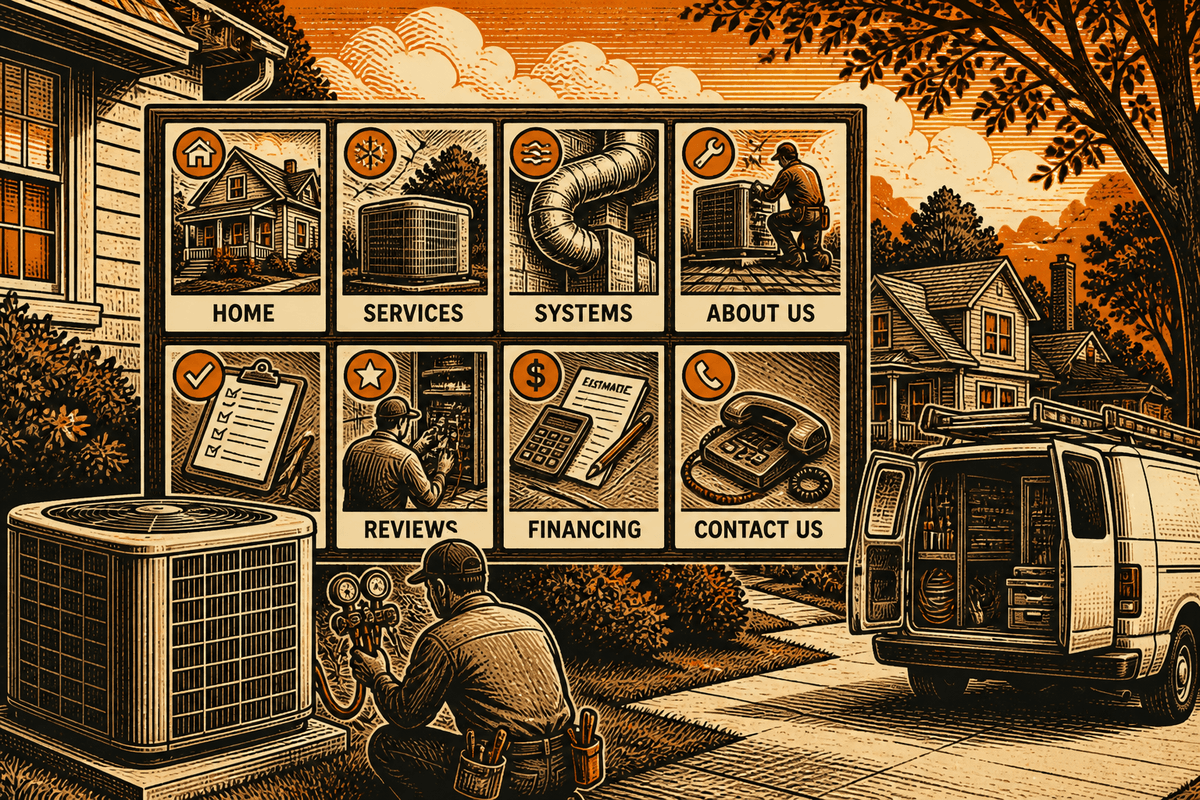
You are on the job site all day. The last thing you want to do after hours is wonder whether your website is costing you calls. But here is the truth: most HVAC websites are missing the pages homeowners actually look for before they pick up the phone. They land on a generic homepage, do not see what they need, and bounce to the next contractor in the search results.
This is fixable. A complete business website, what we call the mothership, gives every visitor a clear path from "just browsing" to "booked appointment." You do not need fifty pages. You need the right pages, built the right way, answering the questions your customers are already asking.
At Fully Loaded Websites, we build HVAC mothership sites that go live in under two weeks. Here is the page structure that actually works.
The Homepage: Your First Impression in Under 3 Seconds
Homeowners do not read homepages. They scan them. Your homepage has one job: prove you are a real, local HVAC company they can trust, then make calling you the obvious next step.
Here is what belongs above the fold, before anyone scrolls:
- Clickable phone number. On mobile, one tap should start the call. No hunting, no contact forms buried three layers deep.
- Service area clarity. State the cities and counties you cover so visitors know you are local to them.
- Primary services listed. Heating repair, AC installation, maintenance plans, whatever you do most. Use the words homeowners actually search.
- Real photos, not stock. Your trucks, your team, your actual installs. Stock photos signal "this company might not even be real."
- Social proof. A recent review, a star rating, or a "serving 500+ local homes" badge builds instant credibility.
Your homepage is also where local SEO starts. The page title, H1, and first paragraph should include "HVAC" plus your core service terms. This tells Google what you do and where you do it.
Want to see how this plays out in a specific market? Our guide to HVAC contractor marketing in Midland, TX walks through homepage strategy for a competitive oil-country market.
Service Pages: One Page Per Core Offering
This is where most HVAC sites fall apart. They list "Heating & Cooling Services" in one generic paragraph and call it done. Homeowners searching "furnace repair near me" or "AC replacement cost" land on that vague page and leave.
Each major service needs its own dedicated page. Not for Google. For the homeowner who wants to know if you handle their specific problem.
The service pages that convert include:
- What the service covers. Be specific. "Furnace repair" should list common issues you fix: no heat, strange noises, short cycling, pilot light problems.
- What the homeowner can expect. Timeline, process, whether you offer same-day service. Uncertainty kills conversions.
- Local context. Mention the climate challenges in your region. In Texas heat, AC load calculations matter. In northern markets, heat pump efficiency ratings matter.
- Clear next step. Every service page ends with a phone number and a simple form. No dead ends.
Service pages are also your best shot at ranking for long-tail searches. "Emergency AC repair" and "new heat pump installation" are different intents. Separate pages let you match each one.
The About Page: Why You, Not the Other Guy
Homeowners do not hire companies. They hire people they trust. Your About page is where that trust gets built.
Skip the corporate mission statement. Instead, tell them who owns the company, how long you have been in business, what certifications you hold (NATE, EPA 608, state licenses), and why you started this work. Include real team photos. Mention your service area again.
This page also ranks for branded searches. When someone hears your company name and Googles it, your About page should confirm you are legitimate and local.
We have written more about this in our piece on writing an About page that builds trust for contractors across every trade.
Areas Served: Capture the Map
Your HVAC business probably covers a radius of towns and suburbs. An Areas Served page, or a series of location pages, captures the searches happening in each one.
This is not keyword stuffing. It is honest geography. If you drive to Parker County for calls, say so. List the towns, mention local landmarks, explain response times. Homeowners want to know "do you come out here" before they call.
For HVAC companies in spread-out markets, this page structure is essential. Our HVAC contractor marketing in Amarillo, TX article shows how rural service areas get covered without diluting your main site focus.
Reviews and Gallery: Proof That You Deliver
Before-and-after photos of installs, maintenance checklists in action, and video walkthroughs of clean, professional work all reduce perceived risk. Homeowners are letting strangers into their homes. They want visual proof you are competent and tidy.
Your review page or embedded review section should pull from Google and Facebook. Do not hide reviews on a third-party site. Display them where prospects already are: your mothership.
FLW includes Reasonable Reviews as part of the Marketing Matrix, so fresh testimonials flow to your site automatically. No manual copying and pasting.
Contact and Emergency Pages: Remove Every Friction
Your Contact page should be impossible to miss and dead simple to use. Phone number, email, service area map, and a short form. That is it.
If you offer 24/7 emergency service, give it its own page. Emergency searches are high-intent and urgent. A dedicated page lets you rank for "emergency HVAC repair" and gives panicked homeowners exactly what they need: a big phone number, a promise of fast response, and reassurance you handle after-hours calls.
The Blog: Answer Questions Before They Become Objections
Your advice blog is where you publish answers to the questions homeowners type into Google. "Why is my AC blowing warm air?" "How often should I replace my furnace filter?" "Heat pump vs furnace for my climate?"
Each post is a doorway into your site. Someone searching for DIY troubleshooting may realize they need a pro, and your phone number is right there. Over time, these posts compound into serious organic traffic.
FLW builds the blog structure into every mothership and can handle the writing for you. Our advice blog covers what this looks like in practice.
Curious who you would be working with? Meet Evan and see the contractor-first approach behind every site we build. Or browse the portfolio for real HVAC and trade websites already live.
The mothership is not a brochure. It is a 24/7 sales tool that answers questions, builds trust, and asks for the call. Every page has a job. When they all work together, your website becomes your best employee, not your weakest link.
How FLW Builds Your HVAC Business Website
You do not need to figure out page structure alone. Our Business Website service, the foundation of the Marketing Matrix, includes:
Every mothership is built mobile-first, because over 70% of local searches happen on phones. We compress images for speed, write service page copy that matches real search intent, and structure the site so Google understands your geography and offerings. The result is a site that ranks, converts, and grows with your business.
We also layer in SEO and AIO from day one, so your site shows up in traditional Google results and in AI answers from ChatGPT, Gemini, and Perplexity. That is where search is heading, and your mothership needs to be ready.
For technical standards and industry guidance, the Air Conditioning Contractors of America (ACCA) offers resources on best practices for HVAC professionals.
Ready to fix this in your business?
Stop wondering if your website is costing you calls. Get a complete HVAC mothership built with the pages homeowners expect and the structure Google rewards.
See Solutions → Call Evan, (828) 767 1181