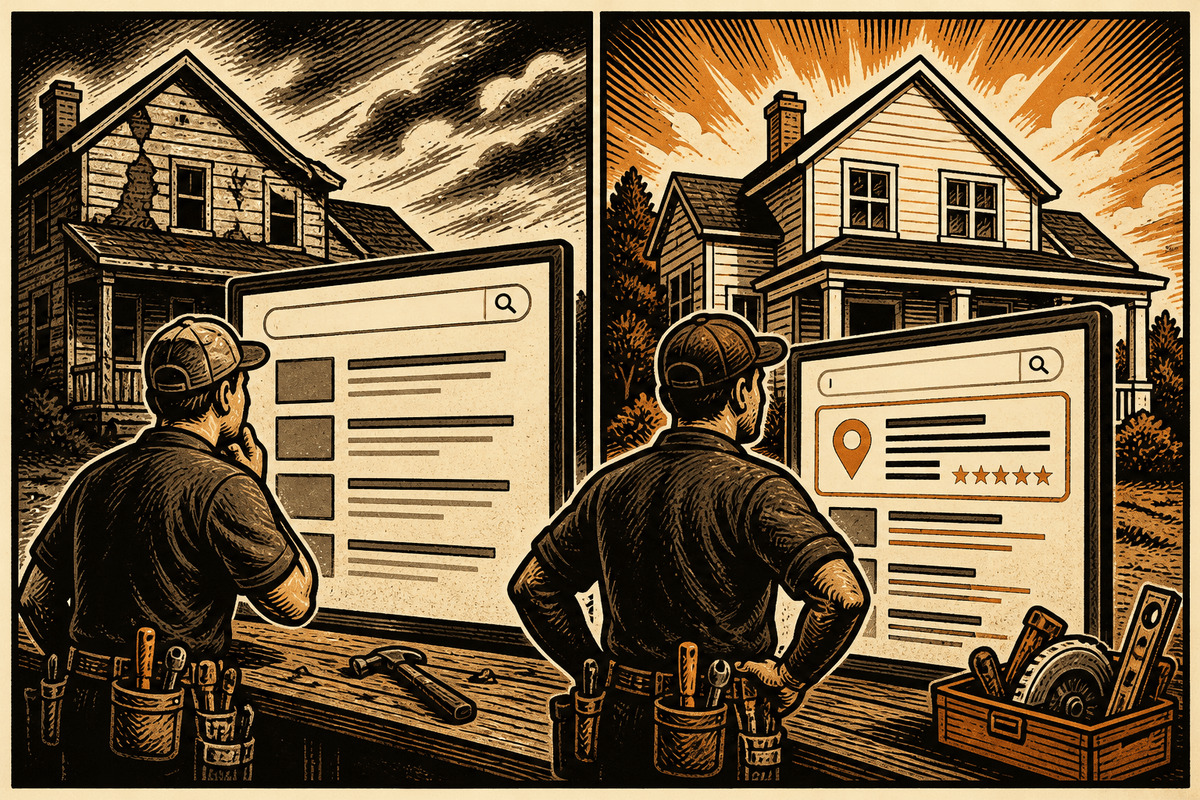
You are on the job site all day. Your phone rings when it rings, and you do your best to answer. But here is the part that stings: homeowners are searching for your trade at midnight, on weekends, during storms, and when pipes burst. They are not finding you. They are finding whoever shows up first.
That is not because you do worse work. It is because your local contractor SEO and AI search visibility are not set up to capture urgent searches. Google Maps, the local pack, and now AI tools like ChatGPT and Gemini are the new front door. If you are not there, you are invisible to the people who need you most.
I have talked to contractors who thought their website was "fine." It had their phone number and a list of services. But fine does not rank. Fine does not show up in AI answers when someone types "emergency plumber near me open now." Fine does not feed the signals Google uses to decide who gets the call.
You can tighten this up. It is not magic. It is a system of signals, categories, and content that tells Google, and AI, that you are the right contractor for that exact moment.
Why Emergency Searches Are Different
Urgent searches have a different rhythm than "planning to remodel the kitchen in six months." The homeowner is stressed, moving fast, and picking from the top three results in the map pack or the first AI answer. They are not comparing ten websites. They are calling the first number that looks credible and available.
Google knows this. Its algorithm weighs proximity, relevance, and prominence harder for urgent queries. It also looks for trust signals: are you open? Do you answer? Do your reviews mention fast response? Is your website mobile-fast enough to load before they bounce?
AI search tools go further. They synthesize answers from multiple sources, so your visibility depends on being mentioned consistently across your site, your Google Business Profile, local directories, and review platforms. If your information is scattered or thin, AI skips you.
The hard truth: a homeowner at 2 a.m. does not care about your brand story. They care that you answer, that you are close, and that someone like them trusted you yesterday. Your digital presence has to communicate all three in about three seconds.
The Map Pack Formula: Categories, Content, and Consistency
Getting into the Google local pack, those three map results with phone numbers, requires more than verifying your Google Business Profile. You need intentional category choices, location-specific content, and consistent citations everywhere your business is listed.
Here is what that looks like in practice:
- Primary category precision. Your main GBP category should match exactly what people search for in emergencies: "Emergency Plumber," not just "Plumber." Secondary categories cover related services without diluting your focus.
- Service pages with local intent. Each major service gets its own page with specific language about response times, service areas, and the problems you solve. Not generic copy. Real details.
- Consistent NAP everywhere. Your name, address, and phone number must match exactly across your website, GBP, Yelp, Angi, and every directory. One mismatch confuses Google and costs you rankings.
- Review velocity with context. Recent reviews mentioning fast response, emergency help, or specific services tell Google you are active and relevant. A steady stream beats a burst from two years ago.
- Mobile speed and click-to-call. Your site has to load in under three seconds on a phone, with the phone number thumb-tappable and visible without scrolling.
I built Fully Loaded Websites around this reality. Contractors do not have time to chase algorithm updates. They need a system that runs in the background, feeding the right signals to Google and AI while they are on the ladder or under the sink.
AI Search Optimization: The New Layer
Traditional SEO gets you into Google results. AIO, or AI Optimization, gets you into the answers people receive from ChatGPT, Gemini, and Perplexity. These tools are growing fast, and homeowners are using them to ask things like "who is the best emergency roofer in my area" or "find a plumber who answers at night."
AI tools do not browse ten pages and compare. They synthesize from sources they trust. That means your business needs clear, structured information that AI can extract and cite. It also helps if you are mentioned in local contexts: chamber sites, news articles, trade associations, and reputable directories.
This is where Brilliant Backlinking, one of the tactics in our full Marketing Matrix, comes in. Strategic backlinks from local and trade-specific sources build the authority that both Google and AI use to decide you are worth mentioning. It is not about quantity. It is about the right links from the right places.
What 24/7 Visibility Actually Means
Being visible around the clock does not mean you personally answer the phone at 3 a.m. It means your digital presence is working even when you are not. The right homeowner finds you, sees proof you handle emergencies, and either calls immediately or bookmarks you for morning.
This requires specific elements on your site and profile:
- Emergency-specific headlines. "24/7 Emergency Plumbing Repair" beats "Quality Plumbing Services" for urgent searches. Match the language people actually use in panic mode.
- Response time promises. "Calls returned within 15 minutes" or "On-site in 60 minutes or less" reduces anxiety and increases conversion. Be specific and honest.
- After-hours contact clarity. If you use an answering service, say so. If you rotate on-call, explain the process. Mystery kills emergency calls.
- Photo proof of real work. Before-and-after shots of emergency repairs build trust faster than stock photos. Homeowners want to see you have handled their exact problem.
You can see examples of how this comes together in our portfolio, where contractors across trades have sites built to capture both planned and urgent searches.
The advice blog also covers related tactics, like how Google Maps ranking works for service businesses and why page speed directly affects whether a stressed homeowner stays or bounces.
Why Most Contractors Lose These Calls
The typical contractor website was built as a digital brochure. It looks fine, lists services, maybe has a contact form. But it was not engineered for search intent, especially urgent intent. It does not have the category depth, the location signals, the review integration, or the speed to win in high-stakes moments.
Most website vendors do not understand the contractor business. They build pretty pages and call it done. They do not think about storm season roof searches, burst pipe midnight panic, or AC failures on hundred-degree days. They do not build for the moment when a homeowner has ten minutes to choose before water destroys their ceiling.
That gap is why I focus on trade-specific marketing. The Solutions page breaks down how SEO and AIO fit into the full 15-tactic Marketing Matrix, from the Mothership website to review generation to social posting that keeps you visible between jobs.
Your Next Step
You do not need to become an SEO expert. You need a partner who already understands how emergency searches work, what Google and AI are looking for, and how to build a system that captures calls while you are doing the work.
The contractors who win these moments are not necessarily bigger or cheaper. They are just easier to find when it matters most. That is a fixable problem. And the sooner you fix it, the more calls you stop losing to competitors who figured it out first.
Ready to fix this in your business?
Get found when homeowners need you most, day or night, on Google and in AI search. See how SEO and AIO work inside the full Marketing Matrix.
See Solutions → Call Evan, (828) 767 1181For more on building authority that AI tools trust, see our guide to local backlinks and authority signals. And if you are wondering how reviews factor into map pack rankings, read about review generation systems that keep your profile active and credible.
Sources: National Roofing Contractors Association (NRCA) for trade-specific best practices; Google Search Central documentation on local ranking factors.